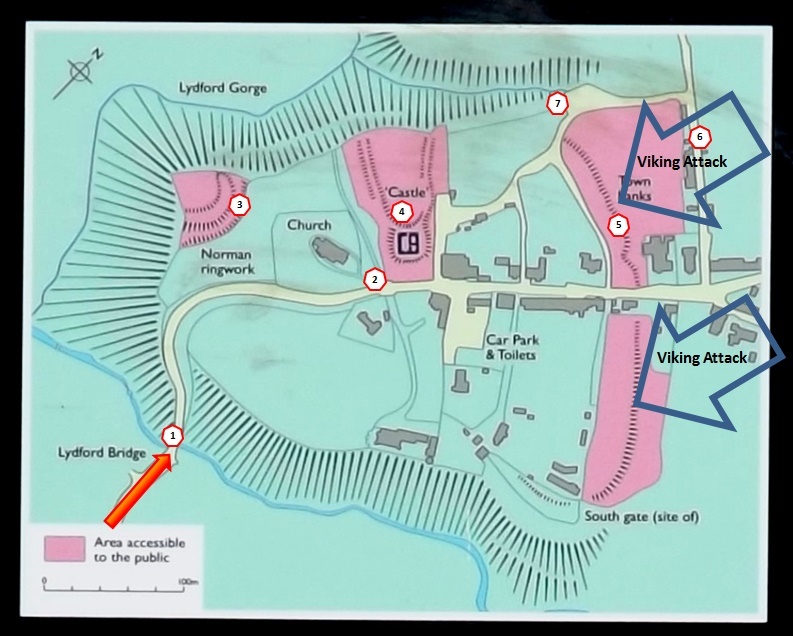
 Detailed excavations and studies have been carried out. If you are looking for detailed information there is an excellent publication called Lydford Castle by A. D. Saunders which gives a detailed account of what has been found and what conclusions have been reached from them.
The History of Lydford Castle
Location and Early History
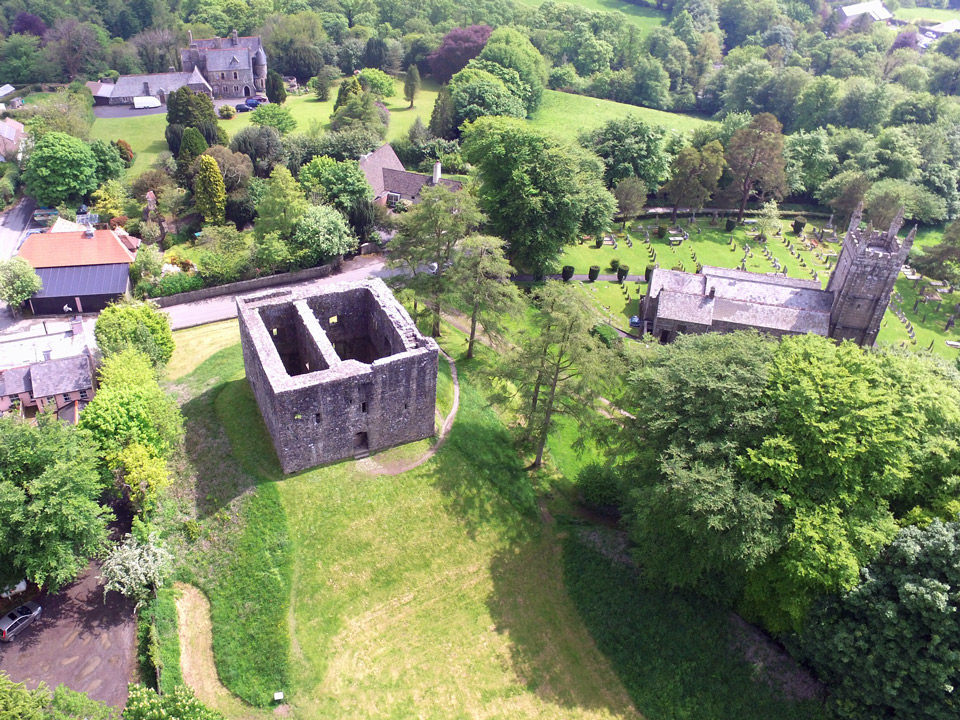
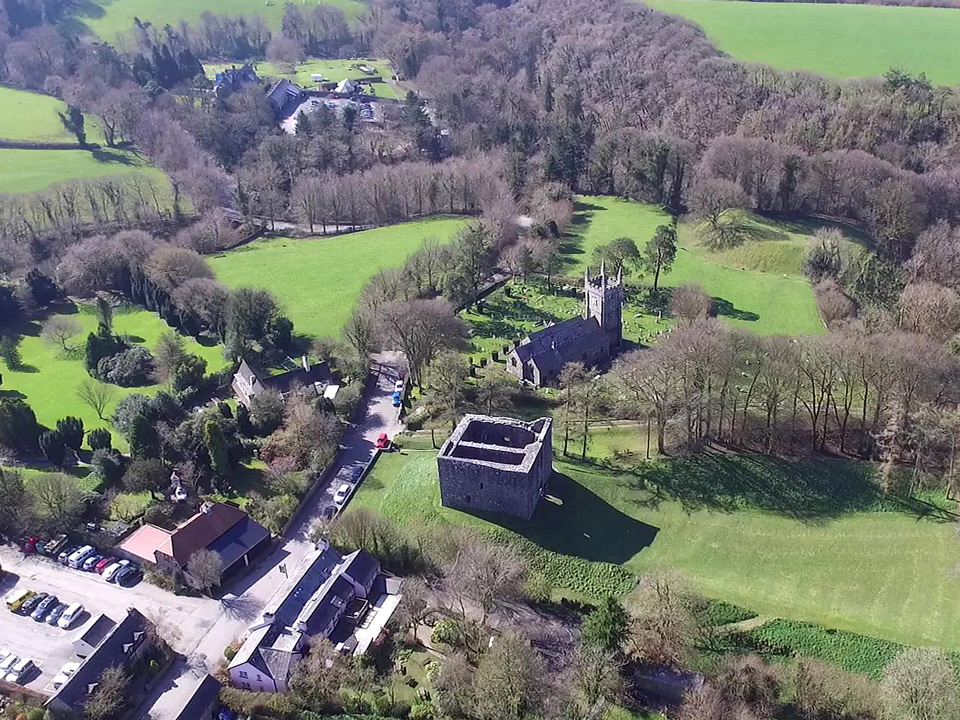
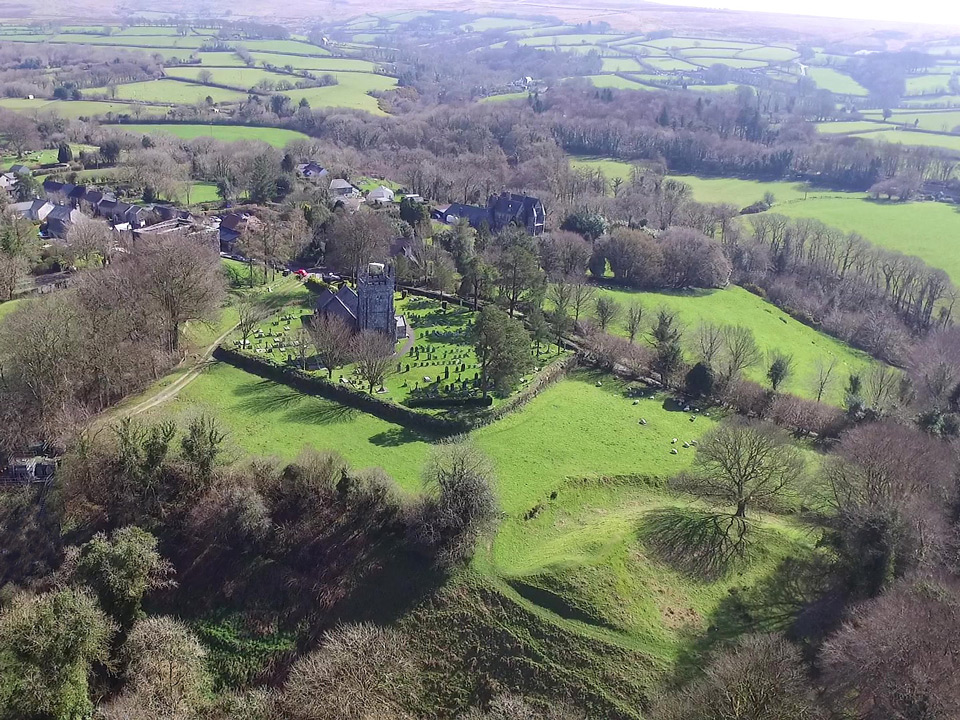
Lydford Castle is one of two castles that have existed in Lydford. The existing visible castle is still impressive and dominant despite now having no roof, and the other, older one, is now totally destroyed above ground, but with its earth-covered foundations and impressive defensive ditch still clearly visible and climbable. The sites of these castles are on the two sides of St Petrock’s Church, located at the south-west corner of the original Saxon town of Lydford, which is the centre of the present village of Lydford.
The Older Castle
The older of the two castles was built very soon after the Norman conquest of AD 1066 on a splendidly defensible site high above Lydford Gorge, with the land falling steeply away from it on two sides towards the river. Though only the earthworks remain, its superb position and stunning views over Dartmoor and the surrounding countryside make it well worth a visit.
The Existing Castle
The later castle, first in the form of a tower 15.8m x 15.8m with walls of thickness greater than 3m and believed to have been of at least two storeys, was built in AD 1195, most likely for the holding of prisoners. The Pipe Rolls record payments of £32 and £42 being made for its construction. It is thought that the lower part of that original building is what is now within and covered by the currently existing and very visible grass-covered mound. That mound gives the (wrong) impression that the castle was built on a small hill. During the 13th century the castle was rebuilt by removing the upper storey of the AD 1195 structure and then adding two storeys, with walls of about 2m in thickness, onto the remaining base. That whole structure was the “Keep” of the castle. The whole base storey was then enveloped by large stones and earth, so forming what is now seen as the grassy mound. Originally that mound was completely surrounded by a close-in deep ditch, the material from which had been used to build the mound.
The present entrance to the inside of the castle is via a pointed (Norman-style) arch in the side of the Keep away from the road; that was the original access way into the Keep from the “Bailey”, via a wooden bridge over the deep ditch, the Bailey being the large and walled open courtyard of the castle, now seen as a large grassy area (still showing the size and shape of the Bailey) on that west side of the castle. Surprisingly, the locations of the gateway of and main entrance to the castle are not known.
When entering the ruined and roofless tower through the archway on the west side of the castle, one can see the massively thick walls of the lowest floor, much thicker than the walls of the two upper floors, and climb down, carefully, by a modern, curved, iron staircase to the now underground level.
Lydford Law
During the Middle Ages, Lydford Castle was used as a prison and as a Court of Law, being the administration office for the Royal Forest of Dartmoor, and also the Stannary Court, which had jurisdiction over the procedures for tin mining in Devon and over the behaviour of the tin miners. The laws relating to the mining, as enforced by that Court, were very strict and severe. For example, the penalty upon any miner found guilty of adulterating tin for fraudulent purposes was that three spoonfuls of molten tin should be poured down into his throat. Furthermore, the conduct of the Stannary Court made it infamous throughout England. A local poet, Browne, of the early 17th century, wrote:
“I oft have heard of Lydford Law,
How in the morn they hang and draw,
And sit in judgement after.”
The Civil War
During the English Civil War (1642–1651), Lydford Castle was used by the Royalists as a dungeon (in the lowest floor of the building) for Parliamentary supporters and soldiers, most of Devon and Cornwall having maintained their allegiance to King Charles I. One of the battles of the War took place on the 25th of April 1643 on Sourton Down, near to the village of Sourton, which is just a few km north of Lydford on the road towards Okehampton, when Royalists, mainly from Cornwall, led by Sir Ralph Hopton and including several other noblemen, fought against Parliamentary forces. The battle lasted into the night, but eventually the Parliamentarians, using heavy guns, were able to dominate, and the Cornishmen fled westward, abandoning all their weapons.
Present-day visitors can immediately see that Lydford Castle was an intimidating and very nasty place during a large part of past centuries.
Visiting the Castle
Lydford Castle is now cared for by English Heritage and can be visited free of charge at any reasonable time. Considerable care and caution should, however, be taken, since there are deep drops and steep stone and iron staircases within the walls of the castle.
History text by Derek W Palmer, from the original lydford.co.uk website (© D W & A P Palmer 1999–2011; D W Palmer 2012).